Apprenticeships and working on production lines in industrial Enfield.


/
RSS Feed
A Collection by Anthony Fisher

Apprenticeships and working on production lines in industrial Enfield.
From an Enfield Poet is a series of podcasts concerning, history, culture, industry, poetry, people most of which will be associated with Enfield. All of interest to me and, l hope, also be of interest to you.
The first four episodes concern people who have worked in Industry in Enfield in the latter half of the last century. The main body of these have been compiled and edited by Soveks Lo of Maroon Community Media from interviews I conducted in my oral history project “Industry in Enfield”

Since 1964 I have worked in Brimsdown the industrial area of Enfield to the East of the borough. The North South Route had not long been built. This is a road running from East London to exit near the M25. Before this the only accesses were at the level crossings at Brimsdown and Ordnance Road Rail Stations which meant the area was somewhat isolated. A rail siding carried goods to and from Delta Metals and there was access via the River Lea. In fact we had one chemical delivered from Germany to Columbia Wharf where it was offloaded from the barge by the Scotch Derrick crane onto a lorry for the final mile.

Brimsdown and Eastern Enfield have always been neglected by the council whether Labour or Conservative and I have always felt that manufacturing industry tends to be looked down upon in Britain and small companies such as mine are always overlooked even though, collectively they contribute around 65% of both employment and GDP.
Imagine my surpise and delight when a Festival of Industry was announced in Enfield. It is a joint venture between Enfield Local History Museum and the Create Enfield cultural team. The museum displays industry Past Present and Future and I am delighted Fisher Research Ltd. is featured along with Chela Ltd.
Create Enfield brought together arists of all persuasions to create individual perceptions of industry in Enfield. In my case I put a call out to poets in Enfield Poets for poems industrial. These can be read and heard at Poetic Voices. Those by Christive Vial and me are from personal experience and the others are reflexions on industry. All very interesting and I hope that you like them.

Poetry fills Enfield’s air, seeps out of the ground so it is no wonder so many poets are associated with this North London Borough. The first for me is:
Henry VIII who liked to hunt in the vast forest that was the Royal Chase.

His palace, Elsynge was located in, what are now, the grounds of Forty Hall.
![[6533] Elsyng](https://i0.wp.com/anthonyfisherpoet.com/wp-content/uploads/2017/11/6533-elsyng.jpg?resize=360%2C247&ssl=1)
Each year the Enfield Archaeological Society excavate the ruins but have to refill them as the masonry is of such poor quality and would deteriorate if left exposed to the atmosphere: though current thinking is that Elsynge was every bit as grand as Hampton Court. It was certainly his favourite palace and was probably more of a family home. His children Edward and Elizabeth spent a lot of time there and it is where they were told of their father’s death and that Edward was to be king. It is thought that much of the planning of the Reformation was carried out here. Nearby Waltham Abbey was the last monastery to be dissolved as the abbot was a friend of Henry.

Looking down towards the site of Elsynge Palace from the second floor of Forty Hall.
In Henry’s time less than 10% of the population were literate. It was important for the monarch to be perceived as cultured as well as having physical prowess and power, It was the time of courtly love and romance and Henry writing poetry was in keeping with the times. Not a great poet by any means but he spent time on it and I feel that a relaxed atmosphere at Elsynge and the hunting encouraged this creative side of the monarch. He often used his poetry as a political tool, reminding all that he was King and that his will should prevail.
When researching for this blog I was very pleased to discover a book edited by Peter C Herman “Reading Monarchs Writing” which has a series of essays and examples of the poetry of Henry VIII, Mary Stuart, Elizabeth I and James VI/I. Apart from Mary Stuart all had lived in Enfield at one time or another. I emailed Peter Herman who gave me permission to quote from his book and here is one of Henry’s poems. It is very political. Though it begins in a defensive apologetic mood, it ends with an overt statement of Royal power.
Though some say that youth rules me,
I trust in age to tarry.
God and my right, and my duty,
From them shall I never vary,
Though some say that youth rules me.
I pray you all that aged be
How well did you your youth carry?
I think some worse of each degree.
Therein a wager lay dare I,
Though some say that youth rules me.
Pastimes of youth some time among–
None can say but necessary.
I hurt no man, I do no wrong,
I love true where I did marry,
Though some say that youth rules me.
Then soon discuss that hence we must.
Pray we to God and Saint Mary
That all amend, and here an end.
Thus says the King, the eighth Harry,
Though some say that youth rules me.
Finally a poem that sums Henry up I feel. It is rather long so I give just the first stanza.
The Kings Ballad
Pastime with good company
I love and shall until I die.
Grudge who likes, but none deny;
So God be pleased, thus live will I,
For my pastance:
Hunt, sing, and dance.

Dr Robert Uvedale planted the first Lebanese Cedar in Europe In the grounds of Enfield Palace, roughly where Pearson’s the department store now is, somewhere between 1662 and 1670.
This is a woodcut showing the tree growing at the back of the palace in, perhaps, the late 19th century.

Image courtesy of the Enfield Local History library
In 1920 Enfield council demolished the Palace and cut down the tree. Lloyd George was prime Minister but I suspect it was a Conservative Council who perpetrated this deed. Luckily he planted a second one on the grounds of Forty Hall and this is still there.

Unfortunately a large branch fell off a few years ago and the bowl in the feature image above was turned from this by a local craftsman.
To mark the spot a Silver Birch has been planted approximately where the tree grew, alongside a granite stele giving details.
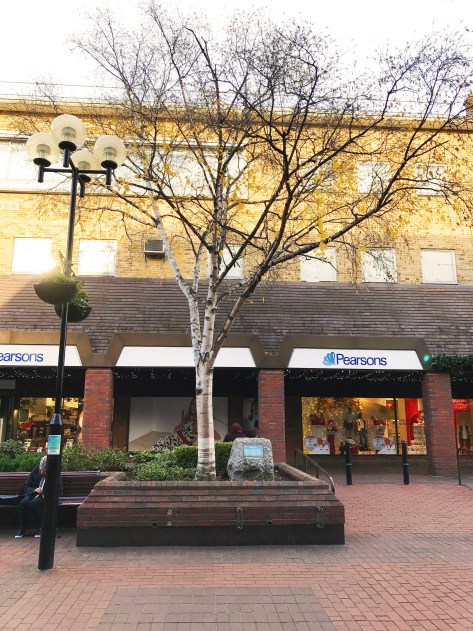
It is a pioneer tree, that is to say it is one of the first to occupy land. It spread across Britain after the last ice age so it is a native of our island which was, in those times, still connected to continental Europe. I think it an interesting metaphor that the Silver Birch has been chosen the represent a tree as exotic as the Lebanese Cedar which did not arrive on our shores until the late 17th century.

I like the featured image above, the shapes and colours its weirdness. It is also a memory of a wonderful weekend Valerie and I spent in Berlin. We went down into a subterranean shopping mall and the complexity of what I was seeing struck me and cried out “photograph me”. That night we were serenaded at our dinner table under the moon and stars by a guitar and violin; the next day it was curry wurst and chips in a converted railway dining car.
The image may be around in a hundred years and someone may like it but will not be aware of what it means to me.
Looking through my collection of postcards over the last couple of days, I was reminded of why, from time-to-time, I buy them ; I like those from between 1900 and 1920. They are often beautiful images, sometimes smaltzy, cheeky and carry memories in the messages on the back. I preferred used cards as it is a link to people in the past. How they were produced is also interesting and I hope to write about this in the near future.

This is of the market in Enfield Town. The post date is 1908. As the split back for both message and address did not come into effect in 1904 it may be the photo was taken between these dates.

The message on the back apologises for not coming that day as the writer had had an accident with their horse and would C. Boosey bring them round on Monday -I think.

Yesterday I took a photo of the market from about the same place. The church is dwarfed by trees, the pine on the left is only half way up the tower on the postcard. The cast-iron bollards are replacements though in the same place. Pub, and the central structure are still there but mostly hidden by cars and fast food outlets.


The cards above are of St. Mary Magdalene at the top of Windmill Hill. The sails were taken off the windmill in 1901 and it was demolished in 1904 so the photo and the painting show the scene between these dates. I feel the painting may be taken from the photograph. The photo graph was posted to Hants. saying this is our church; can’t read the rest. Here is a photo of the same scene, taken yesterday, from about the same spot yesterday.

Not a rural scene now with a farm horse but farms still form 22% of Enfield’s area though 51% is built on. I suppose the tiled tower is a reference to the windmill though it was a smock windmill which refers to its shape I imagine.
Our French house is in St Maixent L’Ecole where the Porte Chalon is one of the notable buildings. It is a triumphal arch built in the late 18th century. Last month we found a postcard of the view from the road.

It is so busy, covered with fly posters and the writer has continued the message on the front a hangover from the time the back could only be used for an address. this changed in 1904. the card is of about this time I think.

It is impossible for me to understand much of the messages on French postcards but I enjoy just looking at the script. Some are so beautiful. Mougon is a nearby town and was posted to someone in the same town. Telephones were rare then.

Here is a photo taken from about the same spot. see how clean and shiny it is. The right hand side is now the tourist office.

And here is the view from Rue Chalon, the other side. The yellow is hand tinting. The clothes look about 1910 or just before. It was much busier then,

as you can see from a photo from, again, the same spot. Behind me in Rue Chalon there are sometimes 20 empty shops in a street of about 300 metres. There is a good food market and street market on Saturdays and it is much busier then.
I just remembered an Audio Visual I made a while ago which has a bit on St Maixent l’Ecole at the end. An early one for me but it was fun making it.
Hope you liked it.

Whitewebbs is a lovely place to walk and we were there with our daughter and three of the eight grandchildren today and discovered something new! This prompted me to post a short piece and I hope it encourages you to visit yourselves.

This photo and that in the heading were taken on the walk uphill to the lake near Whitewebbs House now a restaurant. It is tranquil and magical. Even passing dogs have a reverent air.
At the lake we fed the ducks – two or three species , coots, moorhens, with food pellets brought by Megan and Jake.


Megan spotted a heron and turtles the other side of the lake and we went to take a closer look.


There were several turtles including a baby one –

which you can see on the back of the large one on the right.
I have never seen turtles in the lake before and I was excited to discover them.

One of my photography heroes is Henri Cartier-Bresson who was a pioneer of street photography of “catching the moment”, which is what I strive to do. He would sling two Leica 35 mm cameras around his neck one of which had an F1.4 lens. I have always wanted such a lens but the price was ever exorbitant; for a decent one. Then good old Panasonic brings out the LX 15 with a Leica F1.4 lens. I can now pretend to be Bresson! F1.4 means a large aperture and, with the wide angle, almost everything is in focus and it will take good photos in poor light. I tried it first at the fantastic Ziggy’s jazz club:
 which is run by Steve Taylor and Josie Frater . Guitarist Nigel Price and singer Tina May , both outstanding performers, were guests. They were backed by the Steve Taylor Trio. The music was just wonderful especially as some Ellington numbers were performed and Steve played a duet with the double bass player. The Big Noise from Winnetka is one of my favourite jazz numbers and the double bass and drums are, perhaps, my two favourite instruments.


It was a great evening especially as I was with Valerie.
The next day we went to Camlet Moat which is on the edge of Trent Park one of Enfield’s many wooded areas. As you can see from the link, some think Camlet Moat is King Arthur’s Camelot. Well, it might be. Camelot means armed camp and I am sure King Arthur had many such around Britain. It is now a wooded, square, moated island though the moat is interrupted by a land bridge and covered in bright green weed.

There used to be votive offerings hanging in the trees but some spoilsport has removed them. To me the ribbons and trinkets were a romantic and sensitive link to the distant path. It is still a special place, the spot where the sacred well was is still there and one of the trees has tremendous energy, I felt it as I approached. Here it is in one corner of the island.

When I touched it and closed my eyes, I could see the trees behind me; it was a very bright, clear image. Not so surprising as trees have their own broadband fibre system, Mycorrhiza, which connects trees together as well as facilitating the absorption of nutriment.
We left the island and crossed the path

to where runners suddenly appear as if they were aliens in strange clothes running from one world to another. We walked into a group of young trees and it was such a lovely sight


Walking back to the car we spotted the Obelisk that is in remembrance of Harold son of the Duchess of Kent.

Looking down from there you can see the house which was home, prisoner of war camp and then university. Middlesex University has left Enfield; a great shame and detriment to the borough.

Finally a picture of me in my favourite chair.

Forty Hall is another of Enfield’s garden and open spaces with the added benefit of a wonderful early Jacobean Manor house. Enfield Council has renovated the house and now the garden so it is much as it was when first built. Down by the river there are the remains of Elsynge Palace where Henry VIII is supposed to have planned the dissolution of monasteries. As the Gunpowder plot was supposed to have been discussed in nearby Whitewebb’s Enfield breathes revolution it seems. With farm and vineyard it is a wonderful place to visit. We walked there the other day and I just want to post a few of the photographs I took.
As we have family and a house in France we are often there and I just love to see mistletoe growing in the trees and there is magnificent collection on one of the trees near the river.

There are many oaks and for the first time I saw some Oak flowers. Never noticed them before.

The Azaleas were in full bloom and wonderful At one time I would travel to Japan and I remember how beautiful they were there. Well, they are beautiful in Enfield too.

Finally some bluebells. Not many but it always gives me a thrill to come across them. They were growing down by Maiden’s Bridge where Raleigh was supposed to have laid down his cloak on a puddle for Queen Elizabeth I to walk on.

It was a lovely walk.
More thoughts following on from my previous blog.
I grew up in a post-war, lower middle class family. We came to Enfield in 1947 as my father had secured employment here after being de-mobbed from the Royal Navy. Thinking back, as I do from time-to-time, some memories glowed more strongly than others and the idea for the poem Ten Things I Learned Before I was Fourteen was born. In the first stanza I am feeling happy and proud that Bill was taking me seriously. He features in The Collection Reek of Alchemy in Elegy to Brimsdown Plating and was patient, kind and gentle though his favoured pastime was to take up the challenge in fairground boxing booths and always win! We moved in 1954 and my feelings changed from happiness and involvement to a stoic loneliness and finally disillusionment. So a poem that shares my feelings and, at the same time, a family history.