Sensuous Ancient Egypt


Christmas 1996, Valerie used some of her redundancy money to pay for a holiday in Egypt, hotel in Cairo then sailing down the Nile.  I was stunned by how beautiful and sensuous the bas relief in the stone walls and how delicate the statues.  How could the artist create diaphanous robes in stone, such desirable bodies?  Four years later, I wrote a poem “In Egypt” which has just come  joint third in the Barnet Poetry competition and this prompted me to post it illustrated by photos.

In the folder in My Pictures dated 1996 are photos scanned in from negatives I took during this trip.  Unfortunately none show a good example of what inspired me but I hope this blog will still be of interest.

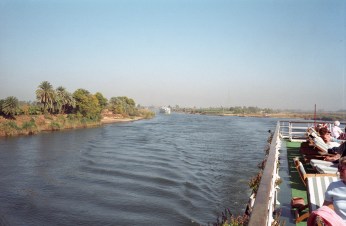
We started in Cairo, one or two nights and, of course visited the pyramids where we saw police on camels whipping away civilian men on camels; they were pestering us tourists.  The museum was wonderful and it is there that I saw the brightly painted clay votive figures.  The next stop was the boat, I think we flew or took a coach to Luxor to meet it. Not too big it was great, good food and a pleasant group to travel with.  It was lovely sitting on the deck in the early evening chatting and drinking, watching the Nile go by.  I was surprised how close the banks were and how green they could be.


On deck

We visited temples along the way to the Aswan Dam and during our frequent dockings that I saw the bas relief and statues that inspired my poem.


In Egypt

Stone breasts croppedFIgures bas relief cropped edited


Columns 3 cropped edited


Many of the images and writings were gouged out.  The new king, in political censorship,  would obliterate the name and face of his predecessor and Christians, in moral censorship, would deface what they thought immoral imagery.  There was still much left to admire and enjoy.

The Felucca were beautiful, serene, silent timeless.

We sailed in one to Elephant Island I think it was.  This is not Elephant Island but I like the picture.

Falucca and island cropped edited

About 10 years later I discovered Enheduanna the first poet who wrote in Sumer in about 2350BCE.  It was an amazing civilization who invented and developed so many things, writing was just one.  Later I found Egyptian love poetry written soon after this.  Both are beautiful and have an unabashed sensuality and eroticism.  This lead me to write some poems relating to both civilisations which perhaps I could write about in another blog.


Hadley Wood and Camlet Lake

We have many woods and open spaces in Enfield, one is Hadley Wood which is an old beech wood a remnant of the hunting Ground of monarchs including Henry VIII.


We often go for a walk here absorbing energy from the trees, just enjoying being in the wood.


I love the way trees make patterns against the sky

and to see the eager young leaves bright green against mute brown.Hadley Wood green Shoots

When the grandchildren were young they would run in the small brook their boots full of water, now it is dry.

Hadley Wood 6

By the Green is Monken Hadley Church.

Hadley Wood Monkon Hadley Church cropped
Monken Hadley Church through the trees.  The beacon is on the roof of this tower.


It is a beacon church and has a brazier up on the roof.  When lit it formed part of the navigation system enabling  travellers to find their way about.  It had an order of nuns who had some healing function.  They would precess down and then up the hill, just over 2 miles,  to Camlet Lake by Trent Park.  There is a healing well in one corner of the square island.  People still hang offerings, scraps of fabric, toys, crystals, all manner of things in the trees there.


Thornbury Castle the Tudors, Bideford the Medievals

Going in to Thornbury Castle

Last weekend we stayed in Thornbury Castle, a genuine Tudor castle whose facilities were, thankfully, up-to-date. Our room was at the top of a spiral staircase, no lift, and had an enormous steel key that Valerie weighed in her hand. We were almost at the top of a tower so


the room was circular with a wonderful view and I spotted a small vineyard in the castle grounds.  It was a large space and had a big four poster bed with a canopy and a wonderfully comfortable mattress.

The grounds were lovely and had an ancient yew hedge that was in the shape of an arch with interesting slits rather like the castellation of the castle walls.


P1010142

P1010135

Henry the VII was the first of the line of Tudor Monarchs (1485 to 1603) and in a way it reinforced the creation of England concentrating power and wealth in the Southeast and enabling the development of English as a language a process which had started over 100 years before.  On leaving the hotel we travelled to Bristol to celebrate a family golden wedding anniversary.  From the venue I could see the second bridge into Wales shrouded in mist and mystery.

P1010151

Henry VII came from Wales and fought his way to the English throne and the union with Wales was signed in 1542 during the Tudor period so seeing the bridge was a natural progression after a night in a Tudor Castle.  I also remembered how we had to drive through Gloucester to get to South Wales and now there are two bridges.

So on to Bideford to stay with some old friends.  The town is very photogenic and has a medieval bridge whose arches are of different spans. The wider the span the richer the merchant who built it. I like being there though the hills are demanding.

P1010219P1010238

P1010235


P1010218

P1010225

P1010229


New at the Dugdale, Jukebox and Poem of the Month


Jukebox
Jukebox Poetry at the Dugdale


Jukebox Poetry is going strong at the Dugdale.  I have just added volume 5

Juke Box Poetry 5


which means, with the other albums we have over 100 or more recordings of poems.  This includes a wonderful Cd by Rik Wilkinson, Flight.Juke Box


As well as recordings we have a poem of the month displayed on two A1 posters, one in the window and the other on the front of the reception desk  This month it is a poem by Ruth Padel, Capoeira Boy.  It is a tremendous poem and it looks great.  The photograph is of the poster in the window.

Ruth PAdel MArch 2017

Londinium. Polyglottal audio video

Well, I have remembered how to embed a video into WordPress and have added the A/V of all 28 translations of Londinium with music and images.   It has been fun choosing images, deciding how to present each language and, of course, struggling with the programme.

Difference gives us strength and I am proud that I live in a city that has people from all over and  speaks 300 languages even though I struggle with languages myself.

I hope that you enjoy it.

Enfield Town Station, D’Israeli and Keats adendum

1257-enfield-town-station-1872The Local History Unit at the Dugdale Centre has just sent me this interesting picture of how the original Station house must have looked.  It was demolished on 1872 and as photography became accessible about 1860 so it would have been taken sometime in this decade.  Looking at the broken glass and boarded windows  I suspect it was taken just before demolition.  I was intrigued to note that only part of the façade is in the V&A, the centre part on the first floor.  The man who built it to show off his bricks would be saddened to see it in this state.  Shame it was long before John Betjeman’s time!

D’Israeli, Keats and Enfield Town Station

The railway came to Enfield in 1849 and the station was opened on March 1st by Eastern Counties Railways as Enfield. It was renamed Enfield Town on 1 April 1886. The original station  was a house built in the late 17th Station and was the birthplace of Issac D’Israeli (he later moved to Baker Street Enfield) father of Benjamin Disraeli. This fine house, built by a rich man who made bricks, was to become a school at which the great poet John Keats was educated. It was demolished in 1872 and the fine 17th-century brickwork facade,  attributed to Christopher Wren, was dismantled, and reconstructed at the Victoria and Albert Museum though it is now hidden behind a false wall and cannot be seen.

Brick Façade of the original Enfield Station Image Courtesy of the V&A
Brick Façade of the original Enfield Station
Image
Courtesy of the V&A


enfield-town-stationThe current station was built in 1957.

Nearby is a gold post box celebrating the Gold Medal won by Charlotte Dujardin in the London Olympic Games 2012 .gold-post-box-plaquep1010044

As well as taking the middle class to work in the City, the original line ran in to Bishopsgate Station,  it was an affordable journey for many working class.  Houses for both the rich and artisans built of London Brick, proliferated.  Enfield had many brickfields so the building material was readily available.


St Maixent l’Ecole and Edmonton Green

Rootling amongst my more ancient  picture files I came across some I still like.  The first two were taken at the annual  World Music Festival in St Maixent l’Ecole where children from all over come to perform their national music and dance.  Valerie and I have been to about three.  One of the most exciting groups was one from Siberia, shamanic dancing, it was thrilling; but no photographs.  It would be great to have such a festival in Enfield.  As well as formal concerts in the evening, the groups move around the town stopping every now and then to dance and sing.  Two images inspired me to a short poem which I incorporated into the image.

Dancer from Eastern Europe

I fire, stamp and sound ricochets through and around.

I burn, flame through the whirls of my skirt,

devour music and song, live in my dance


Dancers from Africa
Dancers from Africa


Who are you looking at who!

I danced in St Maixent as drums and bells sounded.

You snatched my image, made me see you.

Who are you looking, who?


Here are some more mainly from Asia.

Finally three from Edmonton Green

fish-monger-and-fish
The Freshest fish stall I know

plantians-pumpkin-yams-2breadfruit-and-yams-edmonton-green


St Savin, Vienne and Montmorillon

The Abbey in St Savin was begun in the mid-11th century and contains many beautiful 11th- and 12th-century murals which are still in a remarkable state of preservation. It has been a UNESCO World Heritage Site since 1983.  Valerie and I visited there last August and the inside of the Church is so beautiful.

p1000891 p1000892 p1000886

The designs are clear and clean, dramatic and it is wonderful to think that they have been there  for 900 years.  It was serene and peaceful which is not always the case.  Church architecture and design can be so beautiful expressing how creative and loving we can be and it is extraordinary that such wonder was created by artists, artisans and craftsmen whose names I will never know.


p1000897


We went on to Montmorillon famous for macaroons – there is a museum – the clay montmorillonite and bookshops; rather like Hay-on-Wye I suppose.


p1000903
The machine is a guillotine for trimming books

p1000909


Some shops where built into the cliff so an internal wall was stone undressed by man.

Behind the pots is rock face.


So back to Epron where we were very pleased to find the large carp have returned.


carp-a4Not the ones we used to watch these were probably fished out of the leat but new ones claiming their territory.


three-carp


Christmas Morning Walk Hadley Wood

No leaves
Christmas Morning Hadley Wood


Valerie and I like to take a walk in Hadley Wood Christmas Morning.  It is a lovely old Beech Wood and near one of the suspected sites for Arthur’s Camelot, or at least that is one theory for Camlet Lake.  The area we stayed in had a great number of Holly trees and bushes and we found a great pile of prunings complete with berries.

p1010068
Holly prunings with berries

The wood is quite well managed with piles of branches and trunks left for insects and wildlife to hunt and live in and fungus to grow.

p1010070
Woodland management
p1010074
Optimistic holly seedling

It was surprisingly quiet and felt as if it were our own wood.  On the way back to the car I found a log with stripes of fungus and an optimistic holly seedling.

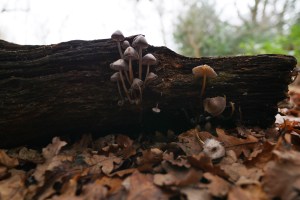
Further on, just before we left the wood, another log with what looked like magic mushrooms.

magic-mushrooms
Magic Mushrooms
enfield-nuthatch
Nuthatch


A couple of days later,  we walked up Bush Hill and along the secret path to the Town.  On the way we chatted to a man who was staring up into an Oak tree.  There was a Nuthatch feeding on insects clinging to the bark even when upside down.

You can just see it right of centre in the photograph on the right.  I had never knowingly seen one before, it was a special moment for us.

We came across the same man as we crossed the little iron bridge over the New River Loop.  “A Pochard” he shouted as we approached him, “and a Spoonbill duck.”

Pochard and spoonbill duck

I’d seen the little red-brown headed Pochard duck many times over the years thinking it was an ornamental addition by the Council.  Not so, its a migrating duck.  The spoon bill was swimming in a tight circle.  “Typical behaviour” he said.


There was once an old branch jutting out over the river where I saw a Heron perching on it eyeing the fish.  It was only about 5 meters away from the path.

There is a long steep and narrow path down to the bridge and I spotted Enfield in the distance through the thicket.

Enfield through the thicket

It looked like a secret and magical town.  The river East of the bridge was frozen, to the West it was golden Water.

enfield-frozen-river
Frozen East


Enfield Ducks on Golden water


As we strolled along the bank I could see what was Bovril house, now flats, across the park

Bovril House
Bovril House
enfield-december-rose
December Rose


and further on where the river runs under Church Street a group of tiny rose blossoms.


Finally a picture of the Town looking East with Bovril House in the distance.  Just on the left is Berndes fresh fish shop, one of the two or three that were in existence in the same position when I came to Enfield in 1947

Church Street Enfield Town