The Horologicon by Mark Forsyth, is another of my books on words in the English language; always a fascinating topic for me. On page 201 is a fascinating list of mating calls: A badger shrikes, a fox clickets, a goat rattles, a deer croons, a sow breems, a cow eassins and an otter whineth. Nothing for us humans although Forsyth does refer to these as “chat-ups”.
Perhaps we rely on pheromones boosted by perfumes and fine words.
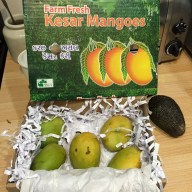
I love mangoes, well I love good ones so much so I have written two poems about them one is a triolet and the other free verse and were inspired after I had eaten a Pakistani Honey Mango. Well the new ones are Kesar mangoes from the Gujarat, India.
My box of Kesar mangoes. The Hass avocado sidled in to be in the photo.
I bought them in the same shop that sells the Honey mangoes I buy later June/July when they are in season.
It is just about the end of the season for these mangoes but they are still delicious with an exciting, quite sophisticated flavour. Not quite the robust blast of pleasure of Honey Mangoes but lovely to eat. Get them whilst you can I say!
I have retrieved my Mango Poem and post it below. The triolet I hope to record with my guitar as I have a simple composition that suits it so I will save it for later and post it on Soundcloud.
Jools Barrett, the designer I collaborated with for this project, has published the posters in Issuu and the link is below. Not the exhibition but a great way to view the posters.
Mark Forsyth’s book, The Horologicon, is a fascinating examination and collection of English words laid out with regard to the relevance of the hour of day. The richness and eccentricity of the English Language is well illustrated and I can recommend it as a delightful read.
To Feague is to insert a live eel into a horse’s rectum. The idea is to cause the horse to lift its tail in a pretty way. What an extraordinary thing to do and how extraordinary for it to have its own verb!
I have learnt that ,bumf, is short for bumfodder a term for toilet paper used in 1653 and, snollygoster, is a good name for all too many politicians as defined in 1890 by an American Journalist.
Needless to say I have had to train the spellchecker but at least there is that facility.
As well as launching the exhibition with a ceremonial cutting of a ribbon by the Mayor of Enfield, Patricia Ekechi, we had a great party with lots of food, including jellied eels, and lovely wines. I was particularly pleased that it was a good social event, everyone chatting and mingling as well as enjoying the exhibition. We are able to play recordings from the jukebox over the sound system. It was, all-in-all, a wonderful evening.
Cllrs. Yasemin Brett and Bernadette Lapage read the French version and Warren Grant, Sonia Jarema and Eve Pearce read the Jamaican English, Ukrainian and Doric versions.
There was a video made and will be soon up on YouTube I’ll post this when it is up. Meantime you might like to read an article which appears in our local Paper this week.
Gold plated ceremonial scissors last used to cut ribbon in 1980 , Japan.Trying them out on the ceremonial ribbon.
A sharp, well-crafted pair of scissors is a thing of wonder, they have a soul, as do all well-made sharp things such as knives and chisels. I love the sound these scissors make cutting the ceremonial ribbon, it is precise, significant.
I found them on EBay in Tokyo and they arrived in only a few days. I wanted something special for the Mayor of Enfield to use to cut the ribbon at the Londinium opening ceremony March 22nd 6pm at the Dugdale centre.
For the Londinium exhibition I needed 25 translations and 25 recordings. The first was Hebrew and the second was to be Hindi.
A poet friend in India, Anuraag Sharma, kindly agreed to translate Londinium for me. I emailed the English version and it came back Hindi! For the Poster I wanted it in script and Devina’s mother transcribed from the standard alphabet into beautiful Hindi Script and emailed it to me. I now needed to find someone to record it so I appealed on Streetlife and Pree Bodasing, who ownsPree-Clean Servicea carpet cleaning company in Palmers Green, contacted me to say his cousin who works as a broadcaster in South Africa may be willing do this for me. So I emailed the poem and back came the recording by Dr Veena Lutchman .
The wonder to me is that I have not physically met any of these kind and helpful people. It has all been achieved through email and the internet and the transfer of files through the magical world of cyber space. Isn’t that just great!
This is a triolet, Railing, that I wrote for my 60th birthday and at 72 I am still railing so I have printed it on a tea towel – for my 60th I had it printed on paper napkins. Well it is a way of getting published! And I have opened an Etsy shop!
I write poems because I want to express how I feel, what I see in order that others may read them, understand me more so I like to have the poems available in all manner of ways.
Another scheme!
Design for the Londinium Exhibition March 21 2016
London speaks about 300 languages and English is derived from about 350. To Celebrate this I am having my poem Londinium, translated into 25 languages for an A1 poster exhibition at the Dugdale from March 21st 2016. I hope also to have recordings so that visitors can listen to the poems as well as look at or read them.
The idea is to celebrate London’s languages and diversity.
This is the design and each poem will have a different colour.
It’s pouring with rain today, all day. Our visit to the flower festival aborted we decided to have a lunchtime drink in the Woodman in Chapmore End. It is perhaps my favourite pub along with the Wonder in Enfield. Small, simple, friendly unpretentious and nowadays it serves good and imaginative food as well as good bitter and now stocks sherry. It is satisfying sitting, talking in such quiet and non-judgemental atmosphere just as people have for a hundred years or more.
There is a picturesque village pond full of optimistic ducks and a bright red, traditional telephone box. One year we sat on the bench, next to the phone box with Bill and Renee, enjoying being there. Bill is no longer with us but I think of him on every visit.
Valerie had her sherry, Peggy lime and lemonade and me tomato juice spiced with Tabasco sauce.
The Woodman – Chapmore End; quiet, unassuming, traditional.Ducks enjoying the rain, as I was!Ever optimistic they saw me and assumed I had food for them. You can just see a flash of red of the telephone box behind the trees.
Our first visit in 2001, about 4 managers ago, was a strange experience and inspired a poem. We enjoyed it very much and have driven there for a drink witnessing changes over the years but it is still, at heart, the Woodman a great pub.
The Woodman – Chapmore End
We walk to the bar,
a terrier shakes and a cloud of dust
bounces around in the winter sun.
An old piano skulks near by,
its veneer of bird’s eye maple and dirt
concealing rhythm and passion.
There’s a Spanish guitar,
a concertina, all are silent.
Here the uniform is old clothes,
fleeces spattered with mud.
It’s seedy, untidy but;
is a real pub,
sells real ale
has real regulars.
We don’t have sherry, don’t have food.
The tall, pale android is polite but firm
wondering why we want these strange things
in a pub that sells good bitter.
There’s no smoke, no mobile phones,
it’s warm and a table’s free – so we stay.
Me with tomato juice Valerie with Scotch,
sharing crisps and a pickled egg
in an English pub.
I like Enheduanna’s poetry, her passion, emotion, lyricism, honesty. Innana is my favourite god and Enheduanna often writes about and to her, even though she is High Priest to Nannathe moon god, at the Temple in Ur. Translated by Samuel Kramer and re-writen by Diane Wolkstien and separately translated and re-written by Betty De Shong Meador, the poems and temple hymns are moving and stimulating as well as giving a glimpse of life in Sumer. Enheduanna’s father King Sargon was an Acadian, a Semite, and his reign marked the end of the Sumerian civilization. Her writings were copied over and over and lived on into the Mesopotamian civilisations. Sumerian literature was highly regarded long after the great Sumerian civilization ceased to exist.
The poem Nin-me-saranowadays translated as The Exaltation of Innana, though I much prefer the translation – Lady of the Largest Heart – is an entreaty to Inanna to restore Enheduanna to her position of High Priestess. Here is Janette Yacoub reading extracts of the poem in Sumerian.
Recital in Sumerian of extracts from Enheduanna’s poem NIN-ME-ŠÁR-RA read by Janette Yacoub. Recording supplied courtesy of the Enheduanna Society


 Mark Forsyth’s book, The Horologicon, is a fascinating examination and collection of English words laid out with regard to the relevance of the hour of day. The richness and eccentricity of the English Language is well illustrated and I can recommend it as a delightful read.


