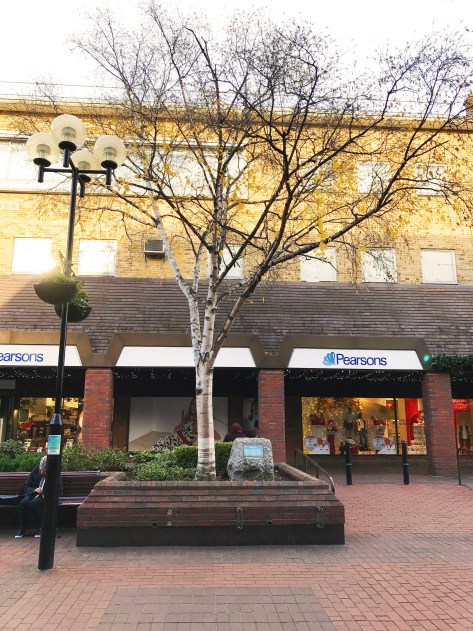
Dr Robert Uvedale planted the first Lebanese Cedar in Europe In the grounds of Enfield Palace, roughly where Pearson’s the department store now is, somewhere between 1662 and 1670.
This is a woodcut showing the tree growing at the back of the palace in, perhaps, the late 19th century.
Image courtesy of the Enfield Local History library
In 1920 Enfield council demolished the Palace and cut down the tree. Lloyd George was prime Minister but I suspect it was a Conservative Council who perpetrated this deed. Luckily he planted a second one on the grounds of Forty Hall and this is still there.
Unfortunately a large branch fell off a few years ago and the bowl in the feature image above was turned from this by a local craftsman.
To mark the spot a Silver Birch has been planted approximately where the tree grew, alongside a granite stele giving details.
It is a pioneer tree, that is to say it is one of the first to occupy land. It spread across Britain after the last ice age so it is a native of our island which was, in those times, still connected to continental Europe. I think it an interesting metaphor that the Silver Birch has been chosen the represent a tree as exotic as the Lebanese Cedar which did not arrive on our shores until the late 17th century.
The quality of acoustically recorded, shellac records is often quite remarkable. Electric microphones were not introduced until 1925 and before then the soloist had to perform into a horn which carried sound to a transducer that converted it to vibrations that were then cut into a wax disc – see link for more detail.
Here is a link to a YouTube video showing the post recording disk-making process. They are using microphones to make the recording and the master disc is made of different material but the plating process and stamping is the same as it always has been. It is about 5 minutes long.
What was achieved by the early record producers and artists was remarkable. Originally sound was stamped onto just one side of the disk and these can have quite splendid graphics pressed into the back. They are also heavier, most satisfying to handle.
From time to time I have bought old 78s and have a small collection in boxes that I need to get out of the junk room and go through them as I have the postcards. It will remind me of why I bought them.
Rootling around in my video files I came across one I made of playing a recording of Amelita Galli ; I had quite forgotten it. Here are a couple of images I have of her,
She has a beautiful voice.
As it is boring to watch a disk playing I thought to add a slide show of photos of shop windows – there is one exception but it is taken through glass. These fascinate me with their colour, designs, sometimes flamboyant sometimes plain and, of course, often with interesting reflections, even of me! I have been trying to think of a poem but so far one has not come to me so, as I wanted to use the photos, I used them in the short video below which I hope that you will play and enjoy.
I like the featured image above, the shapes and colours its weirdness. It is also a memory of a wonderful weekend Valerie and I spent in Berlin. We went down into a subterranean shopping mall and the complexity of what I was seeing struck me and cried out “photograph me”. That night we were serenaded at our dinner table under the moon and stars by a guitar and violin; the next day it was curry wurst and chips in a converted railway dining car.
The image may be around in a hundred years and someone may like it but will not be aware of what it means to me.
Looking through my collection of postcards over the last couple of days, I was reminded of why, from time-to-time, I buy them ; I like those from between 1900 and 1920. They are often beautiful images, sometimes smaltzy, cheeky and carry memories in the messages on the back. I preferred used cards as it is a link to people in the past. How they were produced is also interesting and I hope to write about this in the near future.
This is of the market in Enfield Town. The post date is 1908. As the split back for both message and address did not come into effect in 1904 it may be the photo was taken between these dates.
The message on the back apologises for not coming that day as the writer had had an accident with their horse and would C. Boosey bring them round on Monday -I think.
Yesterday I took a photo of the market from about the same place. The church is dwarfed by trees, the pine on the left is only half way up the tower on the postcard. The cast-iron bollards are replacements though in the same place. Pub, and the central structure are still there but mostly hidden by cars and fast food outlets.
The cards above are of St. Mary Magdalene at the top of Windmill Hill. The sails were taken off the windmill in 1901 and it was demolished in 1904 so the photo and the painting show the scene between these dates. I feel the painting may be taken from the photograph. The photo graph was posted to Hants. saying this is our church; can’t read the rest. Here is a photo of the same scene, taken yesterday, from about the same spot yesterday.
Not a rural scene now with a farm horse but farms still form 22% of Enfield’s area though 51% is built on. I suppose the tiled tower is a reference to the windmill though it was a smock windmill which refers to its shape I imagine.
Our French house is in St Maixent L’Ecole where the Porte Chalon is one of the notable buildings. It is a triumphal arch built in the late 18th century. Last month we found a postcard of the view from the road.
It is so busy, covered with fly posters and the writer has continued the message on the front a hangover from the time the back could only be used for an address. this changed in 1904. the card is of about this time I think.
It is impossible for me to understand much of the messages on French postcards but I enjoy just looking at the script. Some are so beautiful. Mougon is a nearby town and was posted to someone in the same town. Telephones were rare then.
Here is a photo taken from about the same spot. see how clean and shiny it is. The right hand side is now the tourist office.
And here is the view from Rue Chalon, the other side. The yellow is hand tinting. The clothes look about 1910 or just before. It was much busier then,
as you can see from a photo from, again, the same spot. Behind me in Rue Chalon there are sometimes 20 empty shops in a street of about 300 metres. There is a good food market and street market on Saturdays and it is much busier then.
I just remembered an Audio Visual I made a while ago which has a bit on St Maixent l’Ecole at the end. An early one for me but it was fun making it.
Cameras today are mini computers with a lens fitted; the software is amazing and something I have not yet got to grips with. Making taking photographs easier has created another problem of being able to use very complicated systems to fully utilise what is on offer. During our trip to France this month, I resolved to try to get to understand some of the sytems available. The scene options I soon discarded as they seem to ruin an image and Photoshop can reproduce the effects anyway. The exception is perhaps the black and white setting which gives a good photo.
I used a polarising filter which organises light and this is why the reflections are dramatic. In addition I learnt how to use manual focus which gives better control over the shot.
This is fuzzy at the edge as I used an effect but you can see how clear the colours and reflections are due the polarising filter.
The left image below is looking upstream and you can see the fish-viewing windows on the left the right hand photo looks down stream so they are on the right. The clarity of colour can be seen.
A polarising filter also cuts out reflections on water but, fool that I am, I did not use it for the following shots. Some of thecarp are over 50 cm. long.
Though I think that not all reflections are bad, they can add an ethereal quality to the photos such as in the one below which is of a sunken dinghy outside of the kitchen window. You can just see one of the ten carp investigating.
The telephoto lens is great fun and for the following shot I used it with manual focus. The spider was only about 5mm long and I was about three metres away. It hangs around the balcony on one of the railings.
The railing he – or she – inhabits is to the right, out of shot. It was our coffee break.
Writing this, looking at the images made me think of how it was 15 years ago. One of my first A/Vs, Epron, starts and finishes at our house a decade ago and you may care to watch it. It is not too long and it gives an idea of how it was after a couple of years renovation. In the beginning there were no doors, roof or windows. Just 200 year old stone walls.
Niort is a biggish town nearby. It has a food market and some odd shops such as this Broccante. It must have been 75 metres long altogether. The proprietor sat reading at a table in the entrance and was taking no notice of what was going on. It is near the river featured in the headline image.
Reflections fascinate me and I spotted a good one in the glass front of the food market.
The colours and contrasts the slight confusion caused by the reflection intrigued me.
I then noticed the figure on the left so I zoomed in. She was about 250 metres away but the camera telephoto coped very well.
I like the vertical lines and the different blues. Even though it was a long distance photo I was able to crop it and still have a reasonable and fascinating image.
Even if the image is poor good old Photoshop can transform it as this profile shot, which I cropped from the main food hall image above, demonstrates. I used an ink outline function. Again it is the vertical lines and blues I find interesting.
Time came to leave and we made our way to Roscoff via Quimper where we stayed the night and what a lovely town it is. Beautiful, gentle, creative and the hotel, Best Western Hotel Kregennwas fabulous, quiet, welcoming and we both had a good nights sleep. Quimper is well worth a visit.
Here is a night shot taken with my ever-present iPhone
and here a day shot taken with a camera.
The street with a single woman walking down seemed an evocative shot; a slope, clean and no litter with the bollards at the end. I like roof tops as well as reflections. The roofs were taken from our hotel window.
We set off for Roscoff but first Valerie wanted to see Brest as it was such a strategic town in World War II. We didn’t stop so there are no photographs. We were amazed as to how many large factories there were along the coast. Every thing seemed new. We then headed towards Brignogan-Plage . The tide was out but the beach looked so interesting with rocks, the boats and trees. I tried out the panoramic setting; I am still amazed by this feature of modern cameras.
We had a picnic of bread with goose rillet, cheese and tomatoes with tea made with water from our trusty Thermos. It is not mentioned in Wikipedia but I believe it was invented in Enfield
The bench was too wet to sit on but was a lovely blue
and the red boat looked very pretty.
The wind was getting up as we set off for the ferry and I was not looking forward to crossing in the tail end of hurricane Ophelia. I sailed a lot with my Dad, in the Thames Estuary, but was never a good sailor. Fortunately I was OK I suspect that the hardening of the bristles in my inner ear which causes my age related deafness, afforded me protection to this dreadful condition.
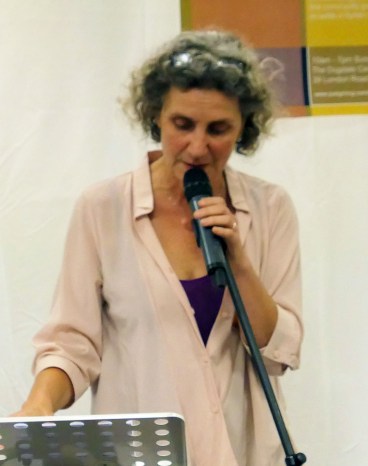
After a night in a noisy hotel room in Torbay we went to hear our friend Jennifer Johnson read at the Torbay Poetry Festival. This is one of the first such festivals in England and is a well known event on the poetry scene held in the Livermead Cliff Hotel with a wonderful view over the bay. I like to hear Jennifer read. Her poems have an honest, well observed quality and are sensitive and heartfelt.
As I was listening I spotted yet an another interesting reflection with commere and organiser Patricia Oxley and one of the audience so out came the iPhone again.
A final look at the fish at Epron. As the wall of the house is the bank of the leat, we can watch them from our kitchen window. As the leat or millstream, is surrounded by private land the fish are safe from fishermen so it is a form of sanctuary. This year there were ten large carp and myriads of little fishes about 10cm long. It is lovely to watch them, both a beautiful and calming experience. Here is a short clip of a couple of meandering carp.
Enfield has long nurtured poets starting with Henry VIII. On October 1st this year 53 poets came together to voice their poems in 8 minutes slots between 10am and 7pm. It was the brainchild of Enfield poet Maggie Butt
Not only was it an exciting and vigorous day it finished on time! An impressive feat of organisation; formidable. It was held in the Dugdale Art Centre and a large part of the success of the project was due to the help and support given by both management and staff. The readings took place in the toy and games museum and in one of the photos you can see “scrabble” which was, for a long time,made in Enfield. The Centre is a good venue for poetry and Enfield Poets , who are poets in residence at the Dugdale, meet in one of the rooms on the first floor.
Getting ready to start.
The aim was to raise money for Enfield Refugee Welcometo enable a refugee family settle in Enfield. The original target of £4,500 – enough to settle one family – was quickly reached and the second target of £9,000 was then over taken and I am sure more than £15,000 will be raised. The money was channelled through the Just Givingweb site which will be open until December 2017.
The whole event was filmed by Ken Sabbarton, a marathon in itself. Nine hours of video would be too much so here is the video clip of my session. I fluffed the last verse of When There Were Gods. If you want to read the poem please click here.
For our Sunday morning walk we went to Hadley Wood to see the Michaelmas Daises. We have a few in our front Garden and they are lovely but there is nothing like seeing them en masse.
Valerie wandered off as I was taking this photograph. She often does this.
She came back and as we were chatting Valerie spotted a Red Admiral. Once so common but now it is even more special to see one.
We also spotted a bay tree someone had sneaked in since our last visit.
Bay is so tasty with its mystery and allure in food but I am not sure if this will be allowed to flourish here.
We headed home through trees that are always so beautiful I must photograph them.
Over the last 50 years, I have tried to learn several languages and though my French is passable and I once spoke reasonable Italian, “frustrated linguist” describes me well. Even at an early stage, I noticed that with each language I was a different person. This gives rise to the intriguing notion that there are many ideas, thoughts and concepts, feelings lurking within me that I cannot express as I do not pocess the appropriate language. What would the Twi me say, how would I feel in Hindi, how would I write poetry in Finnish? This difference alone makes it important, I feel, for our communities to have several languages. English yes for day-to-day and to maintain social cohesiveness but other languages to bring difference, strength and beauty.
Planning or conscious action is not my strong point, as Valerie would tell you, but in April last year I mounted an exhibition that is a metaphor for the benefit of difference. My poem, Londinium, in 28 languages printed on A1 posters, designed by Jools Barrett, at the Dugdale Centre, Enfield. A link to the index of all the poems is at the bottom of this blog or you can click here.
Here is the English version
I wanted to celebrate the 300 languages currently spoken in London and the 450 English is derived from. Here is a list of the top 40 languages spoken in London
Top 40, of 300, languages spoken in London
The fact that London’s population consists of people from such a variety of nations gives it great strength and vitality and, of course, London has, from the beginning been full of people from all over.
Even Pigeons
It was first built by the Romans in the early 40s CE and the legions and administrators were from all nations across the Roman Empire so right from the start London’s population has been diverse. This particular spot for Londinium was chosen as the Thames narrows here yet is still tidal so sea going vessels could sail or row upstream to dock and unload. It is still used to transport goods.
Though I am not sure how this yacht managed to berth in Trafalgar Square!
English owes its origins to migrants, the Angles, Saxons and Jutes who came to England in about 450 CE pushing the Britons west into Wales and Cornwall. The latter’s Celtic language is now mainly found in place names or geographic terms in modern English but is still alive as modern Welsh and Cornish. The early English language was pushed into the background by the NormanConquest in 1066 when Norman French became the language of power although Norman French was spoken in the Royal courts before the conquest due to the somewhat complicated relationship of the rulers either side of the Channel.
Post Conquest, English was the least important of the three languages mainly spoken in England namely Latin, Norman French and English. Welsh and Gaelic would also have been spoken to a degree and, no doubt, there were pockets of Saxon. It was Chaucerwriting in the 14th CE who started us along the path that has led to the dominance of English today; or at least, English and American.
I find thinking on the origins of language fascinating. When one of the proto human species became omnivore its teeth and jaw became smaller as it did not need to munch on seeds and roots. The reduction in size made the lips and tongue nimble enough to articulate sounds. Becoming bipedal caused a section of the brain to develop so as to enable this and also find the rhythm to walk This same section is used for music which led to vocal communication. The first Homo Sapiens in Africa about 200,000 years ago acquired a gene that enabled their brain to break holistic sounds of communication, to segment a stream of sound, into chunks which led to words. Speech is thought to have started to develop around 170,000 years ago and became embedded in Homo Sapiens around 50,000 years ago. It enabled co-operation and thinking which caused the Neanderthalsto become extinct as Homo Sapiens were just too efficient at living. This can be deduced from the explosion of art, decoration and ritual which needs social interaction and good communication For detailed information I suggest the fascinating book, theSinging Neanderthals by Steven Mithen.
The poem Londinium floated into my head as I was reading about London and I can recommend Peter Ackroyd’s books, London, the Biographyand London Under. There are others on my shelf but I particularly liked these. Boudicca burnt Londinium in 50 CE and there is still a line of burnt ash and iron between all the buried history of London and where we walk today. I love the idea of all the archaeology of London cupped in the line of ash from Boudicca’s burning and the pavements on which stroll and London has always been noisy. In the 17th Century the vigorous ringing of hand bells became a fashionable way to exercise adding to the noise of the smiths, wheelwrights, carpenters all hammering and crashing. Think of it, thousands of bells sounding everywhere in London all day and night. London has always been stinking, smoke laden, busy with tanners, burning rubbish ,the soap makers, human and animal excrement in the street, urine being collected and used to wash clothes in public laundries and all those unwashed bodies and bad teeth!
In its beginning the River Thames was very wide and dotted with islands or eyots. Building over the centuries has narrowed it to where it is today and the rivers feeding it covered over. You can see in these two photographs looking taken from The Eye, that the Thames basin is huge giving some idea as to how wide the Thames would have been.
Last year a French mother and daughter, friends of our grandson, stayed with us for their first visit to England. They were overwhelmed at how friendly and helpful Londoners were. London is friendly and accepting, this is its great strength which is why I ended my poem as I did.
This statue at Liverpool Street station is in memory of the Kindertransportwhich enabled Jewish children to escape Nazi Germany They were given homes all over Britain.
A friend, who is an Israeli poet, translated Londinium into Hebrew. I was very excited, a poem of mine in Hebrew! I then began to wonder, what could I do with it? I do not speak Hebrew so cannot perform it. If, I said to myself, I had a few other translations I could print them and put them on a wall. Well this thought led to another and another and 27 languages later I had the basis for an exhibition. Paul Everitt Head of Culture for Enfield, introduced me to the designer Jools Barret who produced some magnificent designs.
The translation process was interesting as metaphor and ideas are different in each language and I had many illuminating conversations with the translators. For the language notes I had with each poster I used two interesting and useful books; Dictionary of Languages by Andrew Dalbyand The World’s Major Languages edited by Bernard Comrie and, of course good old Wikipedia.
All the translations, including English, can be found by clicking here. Just click on the language in the list and you will find the poem on the page and with an audio recording of the poem being read in that language and if you scroll down, the poster and language notes from the exhibition. Before you visit these pages please view the video below. The idea came to me whilst travelling on the train to Liverpool Street Station. The carriage was full of people speaking in a multitude of languages at the top of their voices. I could not understand any of them but it sounded fun, was exciting.
We visited Whitewebbs Park again last weekend past this “Old Man’s Beard” and into the woods…
past the beautiful river.
There was a man shovelling mud in the cast iron aqueduct and, he didn’t see us and I did not want to disturb him. We were looking for the dam but some chain link fence had appeared so maybe the route is blocked now.
Not far from a fallen beech Valerie spotted an enormous toadstool; she is much better at spotting things than I am as I tend to stride ahead into the tunnel before me.
Does any one know what it is? It was just magnificent.
As we made our way uphill to the lake we discovered a stone memorial to Ranger, who we assume to be a dog. It looked a costly monument but there was a big house where there is now a restaurant.
The ducks were friendly and unafraid and I was able to take better shots of the turtles who were sunning them selves on half-submerged logs…
and one of a rather lovely water lily.
It was then home and here is photograph of me in my untidy corner gazing at you all wondering what to write.
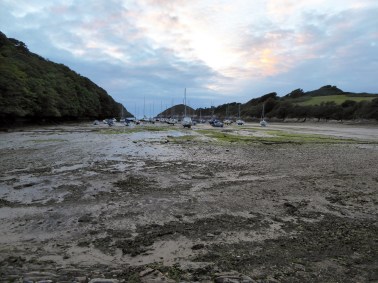
We recently rented a cottage for along weekend with old friends. Valerie and Becky have known each other for nearly 70 years! It was in Watermouth Cove, Devon and, although the cottage was a bit seedy, it was a lovely place to be.
We missed seeing the cove at full tide, we were often out and the 13 hour cycle was out of sync with us.
The top end was an untidy jumble of a boat yard, they always seem to be like this like this. One evening I watched a huge mobile crane creep from the hard across the beach to the work shop where it lifted a shiny engine destined, I suppose, for one of the yachts being worked on.
I sat on a bench and chatted with someone who told me that there are pockets of Cornish-like language in Devon.We were both interested in languages and dialects. He was Cornish but now lived nearby.
Looking out to sea I realized that, as the sea is an electrolyte and with layers due to temperature, pressure and concentration variations it is in the way of a neural network that connects us with all continents and islands and boats bring people to and from our land, eels travel from the Sargasso sea to our rivers. It should nurture, help us understand others and enable development.
The second day we went to spend the day in Ilfracombe. We parked above the town which was great as we were able to see the statue “Verity” by Damian Hurst who lives nearby.
It was quite a dramatic sight and I was pleased to see it from a distance. Public art, especially statuary can be dramatic like this and always gives a lift to the ambiance of where ever it is.
On the walk down to the town we passed a tumble of fishing nets and lobster or crab pots. It smelt strongly of fish and the sea. The air in our town is sterile the same as in all towns and cities but in the country and by the sea it has character, dung in a field, animals, old fish and the sea.
There was, as ever, a seagull eying us up, gauging if we were a source of food or not.
We came across some Morris dancers in this case Border Morris. A friend who plays accordion for Morris Dancers tells me he saw dances in north west India who danced as the Morris does in England. It is said the blacked faces were a disguise to prevent persecution in witch-hunt days. I feel it could be a reference to the black faces of the doddymen who lit the navigational beacons long ago; perhaps. The tattered coats remind me of the watchers wearing long cloaks made of feathers I saw in a vision, or they could be a reference to shamanic coats.
“Black face, tattered coat,
thwacking sticks to sensuous tunes.
They’ve danced for cent’ries”
Here they are dancing. Like an idiot I had my iPhone upright so the video is narrow!
Verity was close by and we went to see her. It is a striking statue of a beautiful young woman in 20 tonnes of bronze. From the harbour’s edge we could see layers had been stripped from some parts of her exposing muscles, sinews and her baby; she is pregnant.
Long ago I gave up trying to understand meanings of art; I just enjoy it now.
There was the omnipresent seagull enjoying the warm, bronze foot.
Up popped another Haiku
“Shapely, defiant
the beautiful Verity.
20 tonnes of bronze.”
After a Cornish pasty, we had a ride in a pony and wagonette. the driver(?) was tall, dark-haired taciturn – though she did tell me how expensive the tyres were and how often they wore out and that she needed the camera to record the idiots she meets as she gives rides – her friend chattered away. ” It is her pony and wagonette, she is my bestest friend.”
“She’s my bestest friend.
It’s her pony and wagonette.
She and I are silent.”
Before we left I took this picture and then we walked back up the hill to our car.
The next day we went to The Valley of Rocks where about 50 feral goats live in the cliffs.
We walked past Castle Rock that had fit, or daft, people dashing up and down but no sign of the goats. Going round North to follow the path at the cliff’s edge we soon found evidence of goats in the masses of droppings, (sadly I did not photograph this). A father told his daughter that it was rabbit droppings and I had a sudden image of giant bunnies bouncing around.
The view from the path was stunning. Looking up the cliff we spotted the goats
one showing us his noble profile. I like goats and once had one in our garden and used to take him for walks on the local green. No one took any notice.
They are intelligent, mischievous and have a sense of fun and yes I like the smell of male goat!
Another Haiku.
“We walk goat-dung trail.
Heavy feet where hooves once danced.
I love to smell goat.”
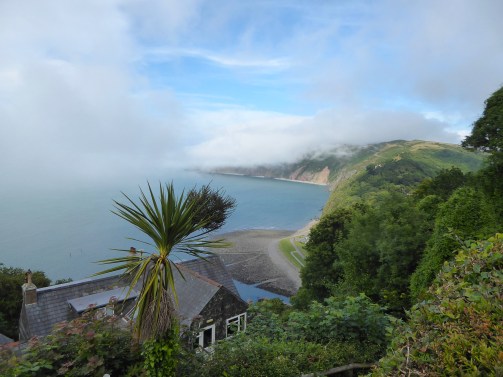
After lunch we went toLynton and there was a great view of goat-dung trail across the bay.
We wanted to visit Lynmouth and took the unusual, possibly unique, cable car down the cliff. It is driven by the weight of water. A tank in the upper car is filled with water from a 100 mm pipe as in the photograph to the right. When the brake is released the weight takes it down. The water in the lower car has been emptied out. As one car goes down the other comes up as they are connected by cables.
Here is a video of the ride. There was a busker playing jazz guitar at the top which gave us a good send-off.
At the bottom in Lynmouth I was impressed by the green of the river bank as it ran under a bridge into the sea.We decided to have a cream tea and were amused to see a jackdaw joining in the fun.
Then it was back up in the cable car and to Watermouth Cove. Next day we headed off to Bideford to stay overnight with Becky and Tony.
The old bridge inBideford is fascinating with its may arches of different sizes. I am told that, as the arches were paid for by merchants long ago, the spans varied depending on how rich the merchant was. The wider the richer. The crane was digging berths for the working vessels that moor against the quay.
Here is a video of this most exciting activity.
Looking the other way there is the new bridge and one of the working boats.
Just in front of this were some youngsters having fun with RHIBS
We took a bus back to the house as Bideford is built on a very steep hill and we were weary.
The next day we drove back to London in almost record time thank goodness.
Whitewebbs is a lovely place to walk and we were there with our daughter and three of the eight grandchildren today and discovered something new! This prompted me to post a short piece and I hope it encourages you to visit yourselves.
This photo and that in the heading were taken on the walk uphill to the lake near Whitewebbs House now a restaurant. It is tranquil and magical. Even passing dogs have a reverent air.
At the lake we fed the ducks – two or three species , coots, moorhens, with food pellets brought by Megan and Jake.
Megan spotted a heron and turtles the other side of the lake and we went to take a closer look.
There were several turtles including a baby one –
which you can see on the back of the large one on the right.
I have never seen turtles in the lake before and I was excited to discover them.






 This statue at Liverpool Street station is in memory of the




 Verity was close by and we went to see her. It is a striking statue of a beautiful young woman in 20 tonnes of bronze. From the harbour’s edge we could see layers had been stripped from some parts of her exposing muscles, sinews and her baby; she is pregnant.


 We wanted to visit Lynmouth and took the unusual, possibly unique, cable car down the cliff. It is driven by the weight of water. A tank in the upper car is filled with water from a 100 mm pipe as in the photograph to the right. When the brake is released the weight takes it down. The water in the lower car has been emptied out. As one car goes down the other comes up as they are connected by cables.
 We decided to have a cream tea and were amused to see a jackdaw joining in the fun.
 The old bridge in


