Ode to Argentic Images – well, almost an ode!

Poem

A photograph, like a poem, can capture the moment, the essence of a person or place and take it straight to our soul bypassing the intellect.  A poem will go through many drafts and some say is never finished but with digital photography an image such as the one above can be printed or disseminated across the internet within minutes of it being taken although, after spotting the opportunity for a shot, I waited some 10 to 15 minutes before the bird spoke to me.  I used to take photos of the members of the Halliwick Penguins Swimming club, my late wife was a member and with my Nikon F fitted with telephoto lens a polarising and blue filter using a 1500 asa Fuji film, I could take great portraits with the correct colour balance and no unsightly reflections from the water.  Everyone would forget I was there as I wandered around the other side of the pool.  Nowadays I would use Photoshop instead of filters.

The image below I took with a telephoto lens on my Panasonic hybrid camera.  Again I had to be patient and wait.

Damsel Fly A4

Sometimes I have had to just point and click as the opportunity was fleeting.  One such occasion was in St Maixent L’Ecole in France when we came across some Eastern European dancers during the annual music festival.  How I managed to capture the dance in action I don’t know.  It was several years ago.  I used Photoshop to change the image and add the poem I wrote to capture the moment.

Dancer from Eastern Europe

The Daguerreotype was the first publicly available photograph and was used between 1840 to late 1850s.  A polished silver-plated copper plate was coated with a light sensitive colloid and exposed whilst still wet.  This could be tens of minutes.  The image was developed by exposing it to fumed mercury, a dangerous process indeed. The image appeared positive or negative depending on the angle of view.  The finished image was very delicate and had to be kept between glass plates.  Unfortunately I have yet to acquire a daguerreotype.

The Ambrotype , introduced in the mid 1850s, replaced the Daguerreotype.  A wet solution of Silver nitrate was applied to a glass plate which was exposed in the camera.  The exposure time was less and the image was developed and fixed in a much safer way and a black lacquer painted over it.  When viewed through the glass it looked like a positive and was the right way round, as the side with the image was at the back under the black lacquer.  A Daguerreotype is a mirror image.

Ambrotype
Ambrotype from about 1860


Tintype hand tinted


The image quality is excellent and sometimes hand tinted as in this image where blue flowers, I believe, have been added to the woman’s hair


Pressed resin case for the Ambrotype


Often the Ambrotype was kept in a small mass-produced, pressed resin case and America supplied most I think.   This means that the images must have been a standard size.


Then came the Tintype introduced in 1860 and used up to the 1930s though I saw a reference to the process not dying out until the early 1950s. An steel sheet is painted with a glossy black lacquer and coated with a solution of silver nitrate and exposed in the camera whilst still  wet.  There was also a dry process with the light sensitive salt held in a thin film of gelatine.  The image was developed and fixed using potassium cyanide, deadly, deadly, but later with thiosulphate or “hypo”.  The image is a negative and a mirror image so left is right and right left.  The black lacquer causes the image to appear as a positive.   It is a robust medium and so many have survived.

Tintypes are perhaps the beginning of what became snapshot photography aimed at ordinary, every-day people and I find them extremely interesting  and have several; they are inexpensive and a valuable social record.  It is absolutely fascinating wondering who they are, why are they having the picture taken.  What was their relationship with each other, what is the story?

Tintype Edwardian


Here an Edwardian couple, seeking a souvenir of their holiday or day out,  posing in a Studio in Ramsgate.


An image could be produced in minutes and were popular in fairgrounds.  The instant photo booth is not new!  Here is one from the USA sent to me by the artist husband of a family friend.

Tintype USA family


It is damaged and a bit crumpled but I like the serious family group and the magnificent beard.  I imagine it being a treasured procession  to be taken out on special occasions or perhaps displayed on a rough log mantle piece; a family heirloom in fact.


The following image is faint and probably means it was taken using the wet process.  Which would have produced a thin film.

Tin type perhaps Edit

It looks a happy group, unusually all are smiling and I love the joy shining out.  It is a mystery as I cannot decide what is nationality of the sitters nor why it has been cut in to the shape it is.

Some Tinplate cameras had up to 12 lenses so could take 12 images at a time.  Here is a photo of one with 4 lenses.


One use for the multi lens cameras is that tiny tintypes, sometimes called “gems” can be produced and these could be incorporated into visiting cards, Carte de Visite.  Below are the front and back of such a card.  On the back is written  an address in Bristol.  I can’t read the rest.  Printed on the card is “9 portraits for 7 1/2” about 15 pence. I suppose this means that the camera had 9 lenses.


Tintype 1920s


When I first saw this I thought “Ah!” 1950s but, on enlarging the photograph I took, I could see that the shoes of the girls in the foreground are pure 1920s.  Another souvenir from beside the sea taken  perhaps by a journeyman photographer.


One of the great functions of my iPhone and Panasonic cameras is that of the panoramic photo.  I have yet to explore it fully but it is great fun.  The image below is of the shrimp fishing structures in Angoulins just south of La Rochelle on the West Coast of France.

Shrimp fishing Angoulins

It was one of the first panoramic photos I took and I was using my iPhone 5.  I am amazed at the detail. Even when printed out 1 metre wide it looked good.

A panoramic camera must have been used for our school photos but I do not have any prints of these.  There is one of me at Pre-medical school in University College London, I wanted to become a psychiatrist but needed to qualify as a doctor first.  I was there for a year after working for one year as an operating theatre technician in a local hospital.  I soon realised that my memory was just not good enough to continue my studies.

UCH Medical school 1962 or 3152 larger

What a year!  Andrew Huxley was professor of physiology – my favourite subject – and he was awarded a Nobel prize for his work on the giant squid neuron.  Boy, was there cheering and hollering as he walked across the quadrangle; it was one of the occasions I will never forget.  If you want to find me, follow the left hand corner of the masonry wall down and I am in the third row up, slightly right of centre.

A panoramic camera was an early development.  Kodak introduced the Panoram No 1 in 1900 just a few years after the development of the first roll film.  I am trying to find one but they are too costly at present so here is a photo of one I captured from the web.

Kodak Panoram No 1

There is no shutter the lens is cocked by pulling to the left or right and it swings in a 120 degree arc projecting the light onto the film held against a curve.  Using 120 film 4 images could be produced.  I found 5 prints produced by the Panoram on a postcard stall and they fascinated me and for £1 were  a bargain!  Here is a couple of them.

Kodak Panoram 1 146

Kodak Panoram 1 145

The poem mentions old postcards from the First World War but they are for another blog; this has gone on long enough.


Red Admiral and Michaelmas Daisies in Hadley Wood


For our Sunday morning walk we went to Hadley Wood to see the Michaelmas Daises.  We have a few in our front Garden and they are lovely but there is nothing like seeing them en masse.

Hadley Wood Michaelmas Daises

Valerie wandered off as I was taking this photograph.  She often does this.

Hadley Wood Michaelmas Daises 3

She came back and as we were chatting Valerie spotted a Red Admiral.  Once so common but now it is even more special to see one.

Hadley Wood Michaelmas Daises 5

We also spotted a bay tree someone had sneaked in since our last visit.

Hadley Wood Michaelmas Daises 7

Bay is so tasty with its mystery and allure in food but I am not sure if this will be allowed to flourish here.

We headed home through trees that are always so beautiful I must photograph them.


Hadley Wood 4


Londinium – Its Genesis

Over the last 50 years, I  have tried to learn several languages and though my French is passable and I once spoke reasonable Italian, “frustrated linguist” describes me well.  Even at an early stage, I noticed that with each language I was a different person.  This gives rise to the intriguing notion that there are many ideas, thoughts and concepts, feelings lurking within me that I cannot express as I do not pocess the appropriate language.  What would the Twi me say, how would I feel in Hindi, how would I write poetry  in Finnish?  This difference alone makes it important, I feel, for our communities to have several languages.  English yes for day-to-day and to maintain social cohesiveness but other languages to bring difference, strength and beauty.

Planning or conscious action is not my strong point, as Valerie would tell you, but in April last year I mounted an exhibition that is a metaphor for the benefit of difference.  My poem, Londinium, in 28 languages  printed on A1 posters, designed by Jools Barrett, at the Dugdale Centre, Enfield.  A link to the index of all the poems is at the bottom of this blog or you can click here.

LONDINIUM_SET_FINAL VISUAL
Here is the English version

I wanted to celebrate the 300 languages currently spoken in London and the 450 English is derived from.  Here is a list of the top 40 languages spoken in London

Top 40 Languages of London
Top 40, of 300, languages spoken in London

The fact that London’s population consists of people from such a variety of nations gives it great strength and vitality and, of course, London has, from the beginning been full of people from all over.

Pigeons and people flattened SH

Even Pigeons

Nelson's Column spiders flattened SH

It was first built by the Romans in the early 40s CE and the legions and administrators were from all nations across the Roman Empire so right from the start London’s population has been diverse. This particular spot for Londinium was chosen as the Thames narrows here yet is still tidal so sea going vessels could sail or row upstream to dock and unload.  It is still used to transport goods.

Barges on the Thames

Though I am not sure how this yacht managed to berth in Trafalgar Square!

NAtional GAlery

English owes its origins to migrants, the Angles, Saxons and Jutes who came to England in about 450 CE pushing the Britons west into Wales and Cornwall.   The latter’s Celtic language is now mainly found in place names or geographic terms in modern English but is still alive as modern Welsh and Cornish.  The early English language was pushed into the background by the Norman Conquest in 1066 when Norman French became the language of power although Norman French was spoken in the Royal courts before the conquest due to the somewhat complicated relationship of the rulers either side of the Channel.

Post Conquest, English was the least important of the three languages mainly spoken in England namely Latin, Norman French and English.   Welsh and Gaelic would also have been spoken to a degree and, no doubt, there were pockets of Saxon.  It was Chaucer writing in the 14th CE who started us along the path that has led to the dominance of English today; or at least, English and American.

I find thinking on the origins of language fascinating.  When one of the proto human species became omnivore its teeth and jaw became smaller as it did not need to munch on seeds and roots.  The reduction in size made the lips and tongue nimble enough to articulate sounds.  Becoming bipedal caused a section of the brain to develop so as to enable this and also find the rhythm to walk  This same section is used for music which led to vocal communication.  The first Homo Sapiens in Africa about 200,000 years ago acquired a gene that enabled their brain to break holistic sounds of communication, to segment a stream of sound, into chunks which led to words.  Speech is thought to have started to develop  around 170,000 years ago and became embedded in Homo Sapiens around 50,000 years ago.  It enabled co-operation and thinking which caused the Neanderthals to become extinct as Homo Sapiens were just too efficient at living.  This can be deduced from the explosion of art, decoration and ritual which needs social interaction and good communication  For detailed information I suggest the fascinating book, the Singing Neanderthals by Steven Mithen

The poem Londinium floated into my head as I was reading about London and I can recommend Peter Ackroyd’s books, London, the Biography and London Under. There are others on my shelf but I particularly liked these.  Boudicca burnt Londinium in 50 CE and there is still a line of burnt ash and iron between all the buried history of London and where we walk today.  I love the idea of all the archaeology of London cupped in the line of ash from Boudicca’s burning and the pavements on which stroll and London has always been noisy.  In the 17th Century the vigorous ringing of hand bells became a fashionable way to exercise adding to the noise of the smiths, wheelwrights, carpenters all hammering and crashing.  Think of it, thousands of bells sounding  everywhere in London all day and night.  London has always been stinking, smoke laden, busy with tanners, burning rubbish ,the soap makers, human and animal excrement in the street, urine being collected and used to wash clothes in public laundries and all those unwashed bodies and bad teeth!  

In its beginning the River Thames was very wide and dotted with islands or eyots.  Building over the centuries has narrowed it to where it is today and the rivers feeding it covered over.  You can see in these two photographs  looking taken from The Eye, that the Thames basin is huge giving some idea as to how wide the Thames would have been.

Last year a French mother and daughter, friends of our grandson, stayed with us for their first visit to England.  They were overwhelmed at how friendly and helpful Londoners were.  London is friendly and accepting, this is its great strength which is why I ended my poem as I did. 

Kinder childernThis statue at Liverpool Street station is in memory of the Kindertransport which enabled Jewish children to escape Nazi Germany  They were given homes all over Britain.

A friend, who is an Israeli poet, translated Londinium into Hebrew.  I was very excited, a poem of mine in Hebrew!  I then began to wonder, what could I do with it?  I do not speak Hebrew so cannot perform it.  If, I said to myself, I had a few other translations I could print them and put them on a wall.  Well this thought led to another and another and 27 languages later I had the basis for an exhibition.  Paul Everitt Head of Culture for Enfield, introduced me to the designer Jools Barret who produced some magnificent designs.

Posters Photo

The translation process was interesting as metaphor and ideas are different in each language and I had many illuminating conversations with the translators.  For the language notes I had with each poster I used two interesting and useful books; Dictionary of Languages by Andrew Dalby and The World’s Major Languages edited by Bernard Comrie and, of course good old Wikipedia.

All the translations, including English, can be found by clicking here.  Just click on the language in the list and you will find the poem on the page and with an audio recording of the poem being read in that language and if you scroll down, the poster and language notes from the exhibition.  Before you visit these pages please view the video below.  The idea came to me whilst travelling on the train to Liverpool Street Station.  The carriage was full of people speaking in a multitude of languages at the top of their voices.  I could not understand any of them but it sounded fun, was exciting.

Whitewebbs – a Quickie with a Question

Thisatles - Copy

We visited Whitewebbs Park again last weekend past this “Old Man’s Beard” and into the woods…


P1000005 - Copy


past the beautiful river.


There was a man shovelling mud in the cast iron aqueduct and, he didn’t see us and I did not want to disturb him.  We were looking for the dam but some chain link fence had appeared so maybe the route is blocked now.

Not far from a fallen beech Valerie spotted an enormous toadstool; she is much better at spotting things than I am as I tend to stride ahead into the tunnel before me.

P1000008


Does any one know what it is?  It was just magnificent.


As we made our way uphill to the lake we discovered a stone memorial to Ranger, who we assume to be a dog. It looked a costly monument but there was a big house where there is now a restaurant.


Memorial to Ranger - Copy

The ducks were friendly and unafraid and I was able to take better shots of the turtles who were sunning them selves on half-submerged logs…

and one of a rather lovely water lily.

Water Lily

It was then home and here is photograph of me in my untidy corner gazing at you all wondering what to write.

Me in my untidy corner


Devon: Verity – Border Morris – Goats, Haiku

We recently rented a cottage for along weekend with old friends.  Valerie and Becky have known each other for nearly 70 years!   It was in Watermouth Cove, Devon  and, although the cottage was a bit seedy, it was a lovely place to be.

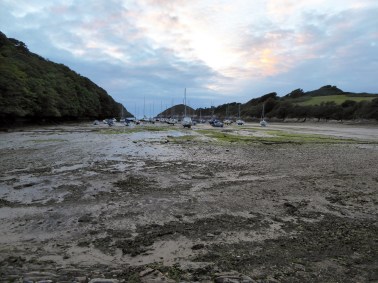
We missed seeing the cove at full tide, we were often out and the 13 hour cycle was out of sync with us.

The top end was an untidy jumble of a boat yard, they  always seem to be like this like this.  One evening I watched a huge mobile crane creep from the hard across the beach to the work shop where it lifted a shiny engine destined, I suppose, for one of the yachts being worked on.

I sat on a bench and chatted with someone who told me that there are pockets of Cornish-like language in Devon.  We were both interested in languages and dialects.  He was Cornish but now lived nearby.

Looking out to sea I realized that, as the sea is an electrolyte and with layers due to temperature, pressure and concentration variations it is in the way of a neural network that connects us with all continents and islands and boats  bring people to and from our land, eels travel from the Sargasso sea to our rivers.  It should nurture, help us understand others and enable development.

Devon Watermouth Cove Valerie


The bay and my thoughts inspired a Haiku.

“Sea-nurtured ideas.

This cove will soon run with them;

she waits with her  own.”


The second day we went to spend the day in Ilfracombe We parked above the town which was great as we were able to see the statue Verity” by Damian Hurst who lives nearby. 

devon veracity 2

It was quite a dramatic sight and I was pleased to see it from a distance.   Public art, especially statuary can be dramatic like this and always gives a lift to the ambiance of where ever it is.

Devon Fishing nets


On the walk down to the town we passed a tumble of fishing nets and lobster or crab pots.  It  smelt strongly of fish and the sea.  The air in our town is sterile the same as in all towns and cities but in the country and by the sea it has character, dung in a field, animals, old fish and the sea.

Devon seagull


There was, as ever, a seagull eying us up, gauging if we were a source of food or not.

Devon Morris dancing


We came across some Morris dancers in this case Border Morris. A friend who plays accordion for Morris Dancers tells me he saw dances in north west India who danced as the Morris does in England.  It is said the blacked faces were a disguise to prevent persecution in witch-hunt days.  I feel it could be a reference to the black faces of the doddymen who lit the navigational beacons long ago; perhaps.  The tattered coats remind me of the watchers wearing long cloaks made of feathers I saw in a vision, or they could be a reference to shamanic coats.

“Black face, tattered coat,

thwacking sticks to sensuous tunes.

They’ve danced for cent’ries”


Here they are dancing.  Like an idiot I had my iPhone upright so the video is narrow!

Devon Veracity 3 extractVerity was close by and we went to see her.  It is a striking statue of a beautiful young woman in 20 tonnes of bronze.  From the harbour’s edge we could see layers had been stripped from some parts of her exposing muscles, sinews and her baby; she is pregnant.

Long ago I gave up trying to understand meanings of art; I just enjoy it now.

Devon Veracity 3


There was the omnipresent seagull enjoying the warm, bronze foot.Devon Veracity 4

Up popped another Haiku

“Shapely, defiant

the beautiful Verity.

20 tonnes of bronze.”


After a Cornish pasty, we had a ride in a pony and wagonette.  the driver(?) was tall, dark-haired taciturn – though she did tell me how expensive the tyres were and how often they wore out and that she needed the camera to record the idiots she meets as she gives rides – her friend chattered away.  ” It is her pony and wagonette, she is my bestest friend.”

Devon Wagonette

“She’s my bestest friend.

  • It’s her pony and wagonette.

She and I are silent.”

Devon Kyaks

Before we left I took this picture and then we walked back up the hill to our car.


The next day we went to The Valley of Rocks where about 50 feral goats live in the cliffs.

P1010751

We walked past Castle Rock that had fit, or daft, people dashing up and down but no sign of the goats.  Going round North to follow the path at the cliff’s edge we soon found evidence of goats in the masses of droppings, (sadly I did not photograph this).  A father told his daughter that it was rabbit droppings and I had a sudden image of giant bunnies bouncing around.

The view from the path was stunning.  Looking up the cliff we spotted the goats

one showing us his noble profile.  I like goats and once had one in our garden and used to take him for walks on the local green.  No one took any notice.

Devon goat on cliff

They are intelligent, mischievous and have a sense of fun and yes I like the smell of male goat!

Another Haiku.

“We walk goat-dung trail.

Heavy feet where hooves once danced.

I love to smell  goat.”


After lunch we went to Lynton and there was a great view of goat-dung trail across the bay.

Devon Lynton 3

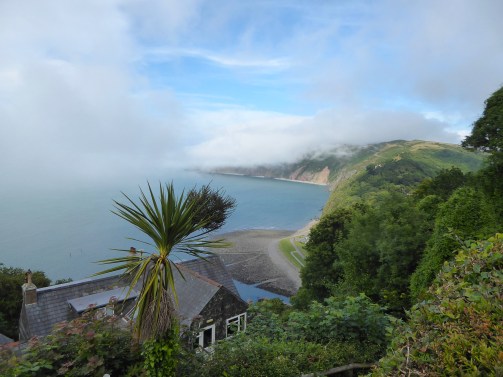
Devon Lynton 2We wanted to visit Lynmouth and took the unusual, possibly unique, cable car down the cliff.  It is driven by the weight of water.  A tank in the upper car is filled with water from a 100 mm pipe as in the photograph to the right.  When the brake is released the weight takes it down.  The water in the lower car has been emptied out.  As one car goes down the other comes up as they are connected by cables.

Here is a video of the ride.  There was a busker playing jazz guitar at the top which gave us a good send-off.

.

At the bottom in Lynmouth I was impressed by the green of the river bank as it ran under a bridge into the sea.Devon Lynton 4We decided to have a  cream tea and were amused to see a jackdaw joining in the fun.

P1010761

Then it was back up in the cable car and to Watermouth Cove.  Next day we headed off to Bideford to stay overnight with Becky and Tony.

Devon Bideford shifting sandsThe old bridge in Bideford is fascinating with its may arches of different sizes.  I am told that, as the arches were paid for by merchants long ago, the spans varied depending on how rich the merchant was.  The wider the richer.  The crane was digging berths for the working vessels that moor against the quay.


Here is a video of this most exciting activity.


Looking the other way there is the new bridge and one of the working boats.

Devon Bideford

Just in front of this were some youngsters having fun with RHIBS


We took a bus back to the house as Bideford is built on a very steep hill and we were weary.

The next day we drove back to London in almost record time thank goodness.


Whitewebbs: Ducks, Heron and Turtles

Whitewebbs is a lovely place to walk and we were there with our daughter and three of the eight grandchildren today and discovered something new! This prompted me to post a short piece and I hope it encourages you to visit yourselves.

Whitewebbs Stump


This photo and that in the heading were taken on the walk uphill to the lake near Whitewebbs House now a restaurant.  It is tranquil and magical.  Even passing dogs have a reverent air.


At the lake we fed the ducks – two or three species , coots, moorhens, with food pellets brought by Megan and Jake.

Megan spotted a heron and turtles the other side of the lake and we went to take a closer look.

There were several turtles including a baby one –

Whitewebbs Turtles

which you can see on the back of the large one on the right.

I have never seen turtles in the lake before and I was excited to discover them.


Tea at the Shard

Our children gave us the very generous Christmas  present of Tea at the Shard.  We decided to wait until the summer to ensure good weather and a clear view.  When we went last week it was raining and cloudy!  The week before, as it happened, I viewed the Shard on the London skyline from the roof of a hotel in Blackfriars.

Shard Skyline from Blackfriars
The Shard from the seventh floor, Blackfriars

It was at an interesting and optimistic breakfast meeting organised by the London Borough of Enfield.

On the way to the Shard  we went to Trafalgar Square,  to see the sculpture of a soldier created to remember the terrible battle of Passchendaele .

Passchandale 2

It was formed of mud and sand from Passchendaele and it brought home to me how awful it must have been living in the trenches, how tired and despondent the troops must have been.  The statue will slowly flow way in the English rain forming a pool of mud and despair.

Passchandale

I hope we never forget this time.  Poppy Day  keeps the memory alive as does the poetry of WWII  ; also the Kodak Vest Pocket camera .

vest pocket Kodak

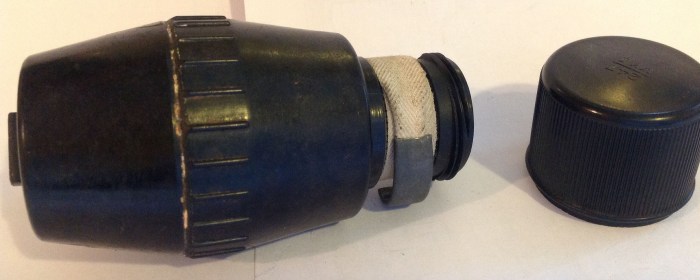
 Introduced in 1912 it enabled people to photograph their loved ones before they left to fight and soldiers to carry one to record their experiences.  This latter was against regulations but they were small, 1″ x 2 3/8″ x 4 3/4 “, enough to hide away.  My grandfather was in the Royal Flying Corps and I have a photo of him sitting on  a shell on a goods train but, of course I cannot find it.  From the size of the picture it was taken with this camera.  He also gave me a Mills Bomb, 

Mills grenade with tape

(deactivated) telling me that he used to drop them on enemy forces from  bi-planes.  He was the observer.  He also dropped flechettes.  flechetteMade of steel they look dreadful things.


V in National Portrait cafeWe then called in at the café in the basement of the National Portrait gallery for a drink before taking the Northern Line to London Bridge Station where we walked a few paces though gusty rain into the Shard and whizzed up 32 floors in a few seconds.


We had a table by the window and the view was breath-taking.

Th thames from the Shard looking East

The window’s dirty, how do they clean them,  and the glass probably is treated to keep the UV out hence the blue cast to the photo but isn’t the skyline interesting?  There is always a crane in London:

There is always a crane

I was amazed as to how many leisure craft moving around at the same time and there were two official looking bright orange RHIBs zooming here and there and two tugs towing barges.

Barges

The one above,  is towing two barges with 28 shipping containers altogether, that is 14 lorries!  The other tug was towing just one barge but this still represents 14 lorries.  The warship is HMS Belfast , well worth a visit.

Now the Tea.  Well the tea, drink, was disappointing little choice and my black tea had little taste but at over 70 I have lost half of my taste buds.  The plate of savouries were wonderful – not shown the this photo unfortunately.

Valerie

Goat cheese quiche, lobster sandwich, black pudding sausage roll and smoked salmon with dill in a small brioche roll.  The scones, see picture above, were delicate well flavoured, crisp on the outside, best I have had since my grandmother made them.  The sweets were dreadful and all tasted the same except for the chocolate cup which had an interesting chocolate crumble inside.

The mix of people was interesting, all ages,  rich, city types, the young, smart, thrusting, people from all over, Valerie and me, and a proud man leading a group of about 15 and his body language shouting ” I am going to pay for this lot!” The staff were super, to use an old fashioned adjective.

Before we left, we went to the loo.  Valerie said hers was all mirrors, she lost herself in images and mine was so stunning I quite forgot what I was there for, well almost.

There was even a light showing me where to aim for and.  I felt as if I was micturating into an exhibit at the Tate ModernLooking down I could see the lines running out of London Bridge Station.

Tarins from the Urinal

I love to see trains, like the concept of people travelling it thrilling and uplifting, mysterious.

We had to leave as the space was turning into a bar.  A price list arrived and I winced.  When I stopped drinking, beer was 58 pence a pint.

A final look down:

Leaving

and we were gone.


Ziggy’s and Camlet Moat Through a F1.4 lens.

One  of my photography heroes is Henri Cartier-Bresson who was a pioneer of street photography of “catching the moment”, which is what I strive to do.  He would sling two Leica 35 mm cameras around his neck one of which had an F1.4 lens.  I have always wanted such a lens but the price was ever exorbitant; for a decent one.  Then good old Panasonic brings out the LX 15 with a Leica F1.4 lens.  I can now pretend to be Bresson!   F1.4 means a large aperture and, with the wide angle, almost everything is in focus and it will take good photos in poor light.  I tried it first at the fantastic Ziggy’s jazz club:

which is run by Steve Taylor and Josie Frater . Guitarist Nigel Price and singer Tina May , both outstanding performers, were guests. They were backed by the Steve Taylor Trio. The music was just wonderful especially as some Ellington numbers were performed and Steve played a duet with the double bass player.  The Big Noise from Winnetka is one of my favourite  jazz numbers and the double bass and drums are, perhaps, my two favourite instruments.

It was a great evening especially as I was with Valerie.

The next day we went to Camlet Moat which is on the edge of Trent Park one of Enfield’s many wooded areas.  As you can see from the link, some think Camlet Moat is King Arthur’s Camelot.  Well, it might be.  Camelot means armed camp and I am sure King Arthur had many such around Britain. It is now a wooded, square, moated island though the moat is interrupted by a land bridge and covered in bright green weed.

P1000027 - Copy

There used to be votive offerings hanging in the trees but some spoilsport has removed them.  To me the ribbons and trinkets were a romantic and sensitive link to the distant path.  It is still a special place, the spot where the sacred well was is still there and one of the trees has tremendous energy, I felt it as I approached.  Here it is in one corner of the island.

P1000026

When I touched it and closed my eyes, I could see the trees behind me; it was a very bright, clear image.  Not so surprising as trees have their own broadband fibre system,  Mycorrhiza, which connects trees together as well as facilitating the absorption of nutriment.

We left the island and crossed the path

P1000034 - Copy

to where runners suddenly appear as if they were aliens in strange clothes running from one world to another.  We walked into a group of young trees and it was such a lovely sight

P1000030 - Copy


P1000032 - Copy

Walking back to the car we spotted the Obelisk that is in remembrance of Harold son of the Duchess of Kent.

P1000038 - Copy

Looking down from there you can see the house which was home, prisoner of war camp and then university.  Middlesex University has left Enfield; a great shame and detriment to the borough.

P1000035 - Copy

Finally a picture of me in my favourite chair.

P1000041 - Copy


Box Camera to Telephoto Lens

Early on, at perhaps 12 or 13 years, I was the proud owner of a Box Brownie not that any photos remain.  Still I would produce it, fiddle with the simple controls and take photos of my family.

Box Brownie

This image, taken from the internet is just how I remember it.

My Father had a Voigtlander that he had taken from a German naval officer, most likely in Denmark where he took formal surrender from the garrisons around the Danish coast.

Bessa_Voigtlander_2_by_Ryan_Warner

Again an image of one from the internet.  Dad let me use it and I felt a serious photographer.  It was beautifully made and I would take it from its leather case just to admire it, the precision and the fascinating way the bellows opened.  He kept it in a cupboard with his enlarger and other developing equipment.  I never saw him develop and print his film but I suppose he had kept it all from before the war.  It inspired me to develop and print – black and white only – my own photos.  I acquired a brilliant Russian enlarger that packed into a small brief case.


images6FP8VBLT
The enlarger packed into the brief case

I was in my early 30s and was slim enough to crouch in the cupboard under the stairs that I had transformed into my darkroom.  I can still feel the excitement as I watched my first print appear; it was magic.  Most have gone the way of all things, though I have a couple or so left.  I swapped it with Dad for his full-sized enlarger which I never used.  All that is left is the base board I use as a ramp for the lawnmower and the lens which is a lovely chunk of glass that  I use as a magnifier; when I can find it.

In the late 60s Dad gave me his Nikon F with Photomic head and three fixed lenses in a wonderful leather case.  I tried to find it just now.  I know I have it somewhere but here is an image from the web again.

nikon-f-photomic-tn


It was a great camera and opened my eyes to how good prints can be with a decent camera and decent glass lenses.  I still like Nikon, sturdy, fabulous optics, reliable; though I now use Panasonic digital cameras.

Until a few months ago, I have never used a telephoto lens.  It is something that I was interested in using but was never sure what I would use it for.  Anyway, as Oscar Wilde advised, I gave into temptation and bought a 150 to 400mm lens – equivalent to 300 to 800 for a 35 mm wet film camera.  It is a work of art and high technology and extremely heavy due to the lenses being glass, as all good ones are.  It is complicated to use and very heavy.  The first pictures I took were of a grey wagtail sitting on her nest.  I had to lean round the corner of the house trying not to fall in the river- or leat to be pedantic – adjusting focal length and focus.

Next day I used a tripod and photographed the damsel flies dancing and courting over the yellow water lilies.

One of the ducklings had been sucked under the sluice gate opposite the balcony but it magically re-appeared.

This is where the Wagtail flies to feed.

Wagtail's retreat

We have found bullets imbedded in the limestone wall and the pock marks from, what looks like, a machine pistol.  The Gestapo were here.   The spirit of an old lady asked us to plant a rose bush in memory of those killed.  A couple of years ago we brought one out from England and several soldiers gathered round at the planting ceremony.  The week before the bush was covered with about 30 blooms but new buds were developing and I photographed one with my new lens.

Rose

The house is tranquil now.


Whitewebbs, trees and the Gun Powder Plot

One of the many woodlands in Enfield is  Whitewebb’s Park.  It stretches from Whitewebb’s Lane in Crewe’s Hill, near the King and Tinker to the Golf course Behind the Rose and Crown in Clay Hill by Hilly Fields.

P1010476

Not as majestic as Hadley Wood it is mysterious and interesting with many secret paths.  The remnants of the New River pass through and there is an interesting iron viaduct which I usually photograph but not this time.  I have just remembered the dam holding back a surprising amount of water.  Must photograph both when we next go.

With open spaces and plantations of little oak trees it is fun to visit.  Up by Whitewebb’s House there is a lake and seats to watch the world go by.


Some of the Gun Powder plot was hatched in the house and the letter that was intercepted leading to the arrest of the gang was dispatched from here too.

We plan a picnic here by the stream.  The grandchildren love playing in it.